Ball clay is prized in ceramics for its plasticity and strength, and both depend on it arriving clean and dry. A trace of the last cargo or a bit of moisture can throw a ceramic body out of spec. Ball clay is used in tableware, sanitaryware, tiles and refractories. This page explains how it is transported in bulk so it reaches your line in spec, and where Den Hartogh can help with ball clay transport across Europe, the UK and Ireland.
Ball clay is a fine, plastic ceramic clay, close cousin of kaolin. For transport the drivers are moisture and contamination:
We move it as a dry powder in sealed pressurised tanks, with a dedicated tank for the most sensitive grades.
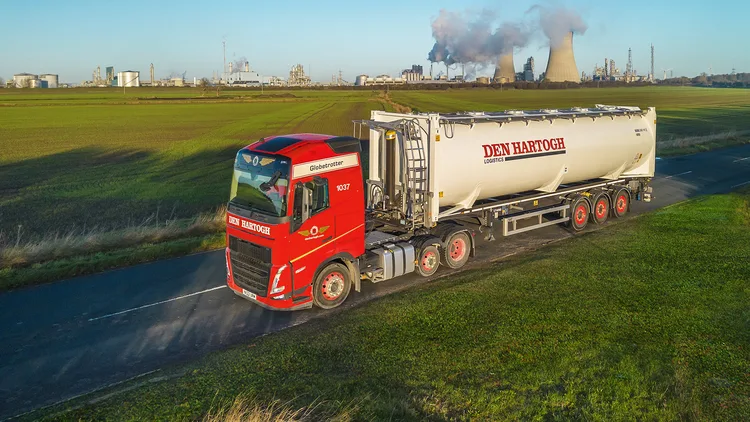
Ball clay moves in enclosed pressurised tanks with pneumatic discharge. The setup is built around keeping it dry and clean:
The discharge is matched to your receiving point, so the tank empties cleanly. For the most sensitive grades, a dedicated tank keeps any previous cargo away from your batch, and that is the first thing we map with you.
Ball clay is produced and traded across borders, including UK and Ireland lanes. We can run the sea leg, the port handling and the inland move as one chain, with customs included, so imports do not hold up your line.
For steady, repeat volumes, rail or short sea can lower cost and CO2 on the longer legs where a lane suits it, and we report the figures for your own use.
If demand peaks with production runs or seasonal work, buffer stock near your plant can smooth supply. Whether it is worth it depends on your stock policy and what a stop costs. In each case the aim is the same: the right grade, dry and in spec, when your line needs it.
Den Hartogh moves ball clay in bulk across Europe, the UK and Ireland. Depending on your grades, volumes and receiving points, we can keep the clay dry in sealed pressurised tanks, protect it through cleaning and a dedicated tank where needed, discharge cleanly into your silo, handle cross-border supply as one chain, and offer lower-emission options where a lane allows. We start from your grades, volumes and receiving points, so the setup fits how your line runs.
Send us your clay types, volumes and receiving points. We’ll come back with a concrete proposal: the tank setup for your clay, how we keep it clean and dry from loading to discharge, and a delivery plan that matches your production.
How do you keep ball clay dry?
We move it in sealed, enclosed pressurised tanks, so no moisture reaches the clay during transport or discharge and it keeps its plasticity.
How do you protect a ceramic grade from contamination?
We clean between loads and keep products separated, with a dedicated tank for sensitive grades, so no residue from the last cargo reaches your batch.
Can you handle imported ball clay?
Yes, including import lanes, with customs and port handling run as one chain.
Do you also carry other ceramic clays, like kaolin?
Yes. We move kaolin and other dry bulk minerals too, so related grades can run on the same lanes.
Is intermodal transport worth it for ball clay?
On the right lane, and given the repeat volumes, rail or short sea can lower cost and emissions. Whether it fits depends on the lane and the timing.
Do you cover UK and Ireland lanes?
Yes, including import lanes.


Chemical site managers are working hard to reduce maintenance downtime during a turnaround (TAR). Den Hartogh can assist in the challenge to work around the clock, first time right and in a short period of time. Our operational teams, managed by experienced project supervisors are ready to perform all the logistics of bulk chemicals relating to your company’s TAR projects.
Discover more

We can transport your Dry Bulk using global containarised transport and road transport. Intermodal transport is the preferred way to move freight over longer distances. Owning over 700 trucks, we can provide both regional as well as international transport. Our scale of combined operations together with our intermodal expertise ensures capacity, pricing efficiency and reliable service to the Food industry.
Discover more

At Den Hartogh, we support dry bulk mineral flows with modern equipment, technical expertise and a practical approach to mineral transport. Rather than focusing on one specific product group, we build on the minerals we already transport and continuously explore new opportunities within dry bulk transport together with our customers.
Discover more

At Den Hartogh, we deliver specialised plastic logistics solutions as part of our wider polymer logistics offering. With strong European coverage, dedicated equipment and a service driven approach, we support reliable polymer transport and plastic transport across complex international polymer and plastic supply chains.
Discover more
Intermodal transport is the preferred way to move freight over longer distances.
It optimally combines various modes of tank container transport.
This method has proven to be a safe, cost-effective, flexible and sustainable way to ensure that shipments are efficiently carried to their destinations.

Owning over 900 trucks, we can provide both regional as well as international transport.
So no matter where your products need to go, we’ll make sure they get there.
Every year, the fleet is expanded with dozens of high-standard new trucks, which are then provided with annual functionality updates by Den Hartogh’s dedicated M&R department.