Cement sets if it meets water, so a damp load is wasted. It is also fine and dusty, and your plant runs to a tight schedule, so a late or off-spec delivery is expensive. Cement and its intermediate, clinker, move in large, steady volumes between works, terminals and concrete plants. This page explains how they are transported in bulk so they arrive dry and on time, and where Den Hartogh can help with cement and clinker transport across Europe, the UK and Ireland.
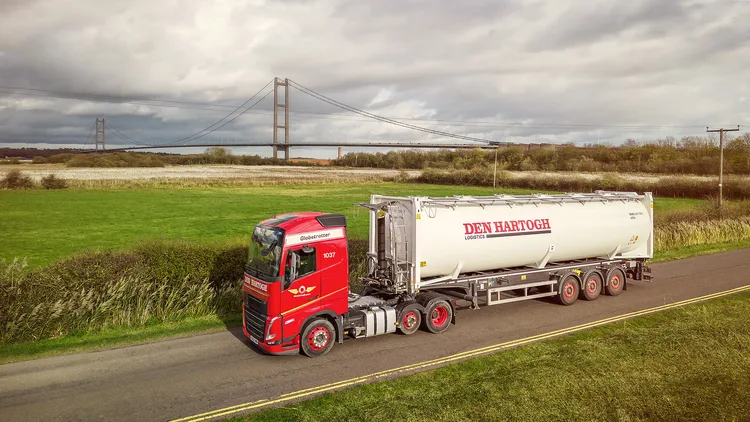
Cement and clinker are stages of the same supply chain, and each needs slightly different handling:
We move both as dry bulk in sealed pressurised tanks, matched to how you receive them.
Cement and clinker move in enclosed pressurised tanks with pneumatic discharge. The setup is built around keeping the material dry and the dust contained:
The discharge is matched to your receiving point, so the tank empties cleanly into your silo. Because cement and clinker are abrasive, we maintain the equipment to keep wear from becoming contamination.
Cement and clinker are traded across borders, including UK and Ireland lanes. We can run the sea leg, the port handling and the inland move as one chain, with customs included, so imports do not hold up your line. Much long-distance clinker already moves by sea, and we can coordinate the inland move that follows.
For steady, repeat volumes, rail or short sea can lower cost and CO2 on the longer legs where a lane suits it, and we report the figures for your own use.
If demand peaks with large pours or seasonal construction, buffer stock near your plant can smooth supply. Whether it is worth it depends on your stock policy and what a stop costs. In each case the aim is the same: dry cement, in spec, when your plant needs it.
Den Hartogh moves cement and clinker in bulk across Europe, the UK and Ireland. Depending on your volumes and receiving points, we can keep the material dry in sealed pressurised tanks, discharge pneumatically into your silo, contain the dust, handle cross-border supply as one chain, and offer lower-emission options where a lane allows. We start from your volumes and receiving points, so the setup fits how your plant runs.
Curious what we can do for you? Leave your details and we'll get back to you as soon as possible.
How do you keep cement dry?
We move it in sealed, enclosed pressurised tanks, so no moisture reaches the powder during transport or discharge, and it arrives ready to use.
How do you control the dust?
Through fully enclosed loading and pneumatic discharge, so this fine powder stays contained. That protects both the product and the people handling it.
Do you discharge straight into our silo?
Yes. The pressurised tank discharges pneumatically into your silo, so the cement goes from tank to storage without handling in between.
Do you move clinker as well as cement?
Yes. We carry clinker as dry bulk between works and terminals, kept dry and clean, and coordinate the inland move after a sea leg where needed.
Is intermodal transport worth it for cement?
On the right lane, and given the volumes, rail or short sea can lower cost and emissions. Whether it fits depends on the lane and the timing.
Do you cover UK and Ireland lanes, including imports?
Yes, with customs and port handling run as one chain, so imported cement and clinker do not hold up your line.

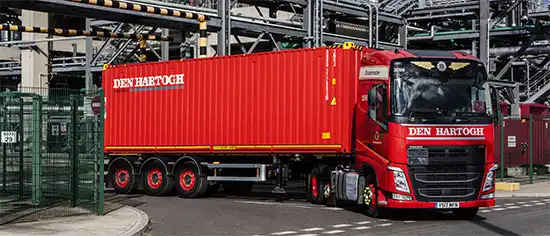
Chemical site managers are working hard to reduce maintenance downtime during a turnaround (TAR). Den Hartogh can assist in the challenge to work around the clock, first time right and in a short period of time. Our operational teams, managed by experienced project supervisors are ready to perform all the logistics of bulk chemicals relating to your company’s TAR projects.
Discover more

We can transport your Dry Bulk using global containarised transport and road transport. Intermodal transport is the preferred way to move freight over longer distances. Owning over 700 trucks, we can provide both regional as well as international transport. Our scale of combined operations together with our intermodal expertise ensures capacity, pricing efficiency and reliable service to the Food industry.
Discover more
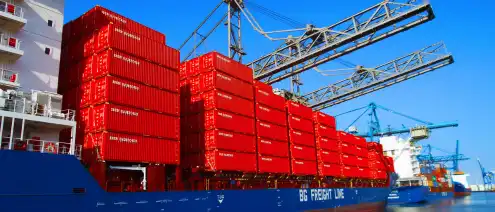
At Den Hartogh, we support dry bulk mineral flows with modern equipment, technical expertise and a practical approach to mineral transport. Rather than focusing on one specific product group, we build on the minerals we already transport and continuously explore new opportunities within dry bulk transport together with our customers.
Discover more
At Den Hartogh, we deliver specialised plastic logistics solutions as part of our wider polymer logistics offering. With strong European coverage, dedicated equipment and a service driven approach, we support reliable polymer transport and plastic transport across complex international polymer and plastic supply chains.
Discover more
Intermodal transport is the preferred way to move freight over longer distances.
It optimally combines various modes of tank container transport.
This method has proven to be a safe, cost-effective, flexible and sustainable way to ensure that shipments are efficiently carried to their destinations.

Owning over 900 trucks, we can provide both regional as well as international transport.
So no matter where your products need to go, we’ll make sure they get there.
Every year, the fleet is expanded with dozens of high-standard new trucks, which are then provided with annual functionality updates by Den Hartogh’s dedicated M&R department.