One partner for ISO tank transport, depot, cleaning and fleet management, on every continent we serve.
Den Hartogh moves liquid chemicals in ISO tank containers across Europe, the Middle East, APAC and the Americas, backed by one of the largest tank container fleets in the industry: 25,000 tank containers, 900 trucks and 54 locations across 27 countries. Whether you need a single shipment, a managed fleet of dedicated tanks, or a full door-to-door chemical supply chain with depot, cleaning and heating, you get it from one accountable partner with ADR, IMDG, RID and CSC certified equipment and people.
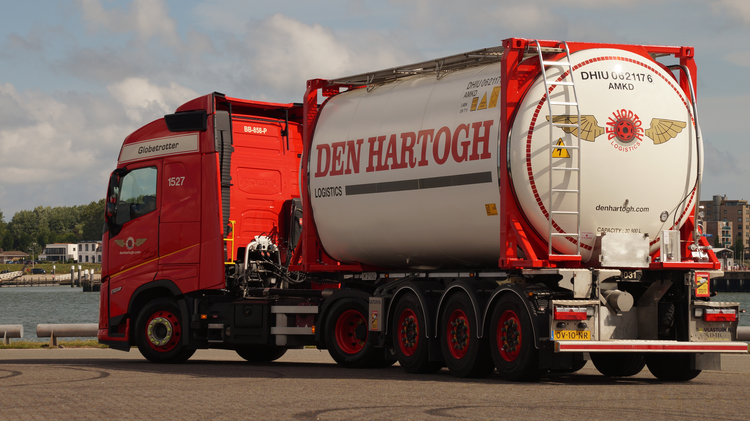
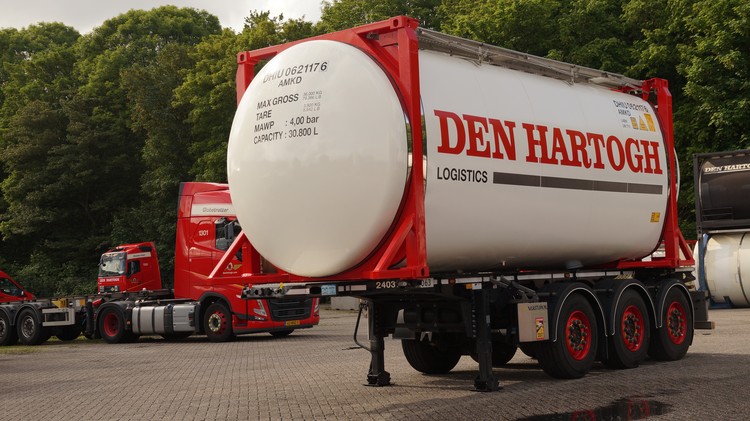
An ISO tank container (also written "isotank" or "iso tank") is a stainless-steel pressure vessel built inside a standardised ISO frame, used to transport bulk liquids, including chemicals, food-grade liquids and gases, by road, rail and sea without changing the tank. Because the frame conforms to ISO 1496-3 and is CSC plated, the same tank moves seamlessly across all three transport modes (intermodal), which makes it the safest and most efficient way to ship liquid chemicals in bulk over long distances. A typical chemical ISO tank carries roughly 17,500 to 26,000 litres, is built to a UN portable-tank "T" code that defines what it may carry, and is fully traceable through its lifetime.
Choosing the right ISO tank is about the product, the route and the regulations. The main types Den Hartogh operates and manages:
If you are not sure which specification fits your product, our chemical logistics specialists select it with you, including the right T-code, lining, heating and cleaning regime.

Den Hartogh handles more than 15,000 different liquid chemical products a year in ISO tanks, including monomers, isocyanates, glycols, latexes, lacquers, inks, drilling fluids, phenols, resins, polyols and herbicides, both ADR-classified and non-hazardous. Through the wider Den Hartogh network we also move food-grade liquids and bulk gases in tank containers, so a single partner can cover adjacent flows.
ISO tank logistics for chemicals is a safety-first discipline. Den Hartogh operates to SHEQ standards and is certified for ADR (road), IMDG (sea), RID (rail) and CSC (container safety), with dangerous-goods expertise embedded across operations and a dedicated employee training institute. Equipment is inspected and tested to schedule, with full documentation. The company is EcoVadis Gold rated for sustainability, and ISO tanks are reused within the network after delivery to cut empty mileage and CO2.
The reason Den Hartogh can take responsibility for your whole ISO tank chain is the network behind it: our own depots and tank container fleet combined with a curated, long-term network of partner depots, terminals and hauliers. Owned infrastructure gives you control and consistency; the partner network gives you reach and resilience. With 25,000 tank containers and 54 locations across 27 countries, your product moves under the same Den Hartogh standards wherever it goes, with one contact and one contract.
Tell us about your transport requirements and we will come back to you with a concrete proposal. Whether you are tendering, facing a capacity issue or looking for a long-term partner for your mineral flows, we are ready to help.
What is an ISO tank container?
An ISO tank container is a stainless-steel tank built inside a standardised ISO frame, used to transport bulk liquids such as chemicals, food-grade liquids and gases by road, rail and sea without changing the tank. It conforms to ISO 1496-3, is CSC plated for intermodal use, and is built to a UN "T" code that defines what it may carry.
How much can an ISO tank container hold?
Most chemical ISO tanks carry roughly 17,500 to 26,000 litres, depending on the product, its density and the tank specification.
What is a baffle tank, and do I need one?
A baffled ISO tank has internal walls (baffles) that reduce liquid surge when the tank is not full, improving stability and safe handling on part-loads. Baffled tanks are more common in food-grade and road-tanker work; for many chemicals a non-baffled (smooth-bore) tank is preferred because it cleans more fully between products. Den Hartogh advises which fits your product.
Which chemicals can be shipped in ISO tanks?
Both non-hazardous and ADR-classified liquid chemicals, including monomers, isocyanates, glycols, latexes, inks, resins, polyols and many more. Den Hartogh handles over 15,000 different products a year.
Does Den Hartogh clean ISO tanks between products?
Yes. Dedicated tank cleaning to the correct standard between products is part of the service and is essential for chemical safety and quality.
Which regions does Den Hartogh cover for ISO tanks?
Europe, the Middle East, APAC and the Americas, through a network of 54 locations across 27 countries, with 25,000 tank containers.
Can Den Hartogh manage or lease ISO tanks for us?
Yes. Beyond transport, Den Hartogh offers fleet management and dedicated or leased tanks, including inspection, testing and documentation, with Control Tower visibility over the fleet.

Intermodal transport is the preferred way to move freight over longer distances.
It optimally combines various modes of tank container transport.
This method has proven to be a safe, cost-effective, flexible and sustainable way to ensure that shipments are efficiently carried to their destinations.

Owning over 900 trucks, we can provide both regional as well as international transport.
So no matter where your products need to go, we’ll make sure they get there.
Every year, the fleet is expanded with dozens of high-standard new trucks, which are then provided with annual functionality updates by Den Hartogh’s dedicated M&R department.